Showing posts with label LIS. Show all posts

Tuesday, June 30, 2015

Nonverbal Communication Resources

The following articles will give one a starting point to explore nonverbal communication.


  1. Collett, Peter. 2004. "Show and Tell: Think You Can See When Someone is Lying?" People Management 10 no. 8: 34-35.
  2. Page, Daniel. 2004. "The Importance of Nonverbal Communication in Library Service." Library Mosaics 15, no. 6: 11.
  3. Whipple, Robert. 2006. "E-body Language: Decoded." T+D 60, no. 2: 20-22.
  4. Xu, Yu, and Ruth Davidhizar. 2004. "Intercultural Comminication in Nursing Education." Journal of Nursing Education 44, no. 5: 209-215.

    These books provide in depth coverage.

  5.  Lawton, Eunice. 2006. Body Language and the First Line Manager. Oxford: Chandos.
  6. Pease, Allan, and Barbara Pease. 2006. The Definative Book of Body Language. New York: Bantam Books.
  7. Ribbens, Geof, and Greg Whitear. 2007. Body Language. London: Hodder.

    This is a really good DVD.

  8. Dresser, Norine, and Joel Asher. 2007. Body Language: Cultural DIfferences. New York: Insight Media

Sourced from:


Evans, G. Edward, and Alire, Camila, A. 2013. Management Basics: For Information Professionals. (3 rd. ed.). Chicago: ALA.


Sunday, June 28, 2015

Outreach Services Assessment Paper

For my management class I had to write an assessment of a couple of library outreach services. Here is the assignment criteria:

In this assignment, you will begin by conducting field research (through on-site visits to libraries, searching library websites, and/or interviewing librarians) and identify two or three examples of effective outreach services. In a paper of no more than 5 pages, you will describe each service and explain how you believe it is part of an effective marketing plan, identify the user group to which it is directed, and reference the elements of marketing plan as defined by Kendrick (see next paragraph) or draw on your other readings on this topic. If the Determine if the library uses social media or other technologies in its outreach – if so, what and how? Do not use a library, information center, special collection, or archive where you work. 

Kendrick defined an effective marketing plan as a plan that “will identify what drives users and build products and services around their needs; enable a highly differentiated service, not ‘one size fits all’; create value and inspiration to use the library; and do all this with as little cost as possible. It will provide a process to ensure maximum use of the public libraries by the public, attract non-users and develop loyalty behaviors in existing users, and will clearly influence attitudes towards the library—our ‘offer’ as the best, the winning offer (in terms of use of time) in the scramble for their attention.” (Kendrick, T. (2006). Developing strategic marketing plans that really work: A toolkit for public libraries. (London: Facet, 2006), 9.)


I choose to write about the Bibliocycle and bWell outreach services at the Boston Public Library. Here is my paper.

 Outreach Services Assessment Paper

Friday, June 26, 2015

SLA2015 Conference

I attended the 2015 SLA conference in Boston, MA June 14-16.

Here is the welcome banner in the Conference center lobby.

SLA Conference Banner.


Here is the welcome slide as people find a seat for the closing speaker.


Closing Speaker Get Ready                                                                                  


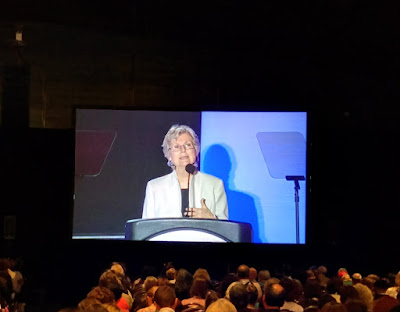
SLA President and MN resident Jill Strand speaking to at the closing ceremony.

SLA President 2014-2015 Jill Strand


A almost full house at the SLA2015 Closing ceremony.

Full house at SLA 2015 Closing Ceremony

SLA 2015 Closing Keynote Speaker Kim Dority, Dority & Associates

Kim Dority SLA 2015 Keynote Speaker

The closing message or take away from the 2015 SLA Conference

The Take Away Message