Friday, July 3, 2015

Smart Chart 3.0

Smart Chart is an interactive communication design tool to help organizations create easy to follow and understand strategic communications. The overview document provides a detailed explanation of the process and is worth reading.


" For those already familiar with previous versions of the tool, here’s a snapshot of what’s different. On this site you will find Smart Chart 3.0 – an even more effective strategic communications tool that builds upon the original Smart Chart. If you follow all the steps – in order – you will finish with a solid communications strategy.

For big fans of the old Smart Chart, don’t panic. We made only slight modifications, primarily to reflect feedback from more than 500 trainings and workshops with nonprofit organizations and foundations for how to make this tool even more user-friendly and effective.

Other updates reflect the findings from our research on the Activation Point. In December 2006, the Communications Leadership Institute partnered with Spitfire Strategies to research the best practices of persuasion. Through focus groups, case study research, an extensive literature review, brainstorms with an expert panel, and a proprietary research tool called PowerGamesTM, we developed recommendations for the best strategies and approaches public interest groups can use to create change by getting the right people to take the right action at the right time. To access the full report, visit www.activationpoint.org.

Based on the Activation Point, we’ve updated the Smart Chart with a new section on audience readiness that will help you gauge the stage of persuasion you need to work through with your audience(s). We’ve simplified some sections of the tool to streamline your planning process. We’ve also added a section to help you plot your communications activities on a timeline and assign key tasks to the key players on your communications team. Finally, we’ve added a section on implementation and evaluation to help you test the rationale for your strategy, and set benchmarks to measure your progress as you put the strategy into action.

Smart Chart 3.0 can make your communications reach and impact even more effective. But despite the changes, we still want you to “think inside the box” and make the decisions in order."


Give it a look and decide for yourself if it is worth your time.

Decisions

I am currently in the process of trying to decide  which of two conferences to attend in the fall.

I am interested in the following conferences:

  • Internet Librarian 2015. October 26-28 at the Monterey Conference Center Portola Hotel & Spa, Monterey Marriott in Monterey California
  • WebSearch University 2015. September 17 - 18, 2015. DoubleTree by Hilton Crystal City • Arlington, VA
    Preconference Workshops: Wednesday, September 16.

    If anyone has a recommendation on which conference is a better bang for the buck, please let me know.

    Thanks,

    Eddy

Wednesday, July 1, 2015

Ted Talk about the benefit of collaborative conflict

I found this Ted Talk during my research on collaborative conflict and I feel it is really worth your time.
Margaret Heffernan: Dare to disagree #TED : http://on.ted.com/g1327

Tuesday, June 30, 2015

Nonverbal Communication Resources

The following articles will give one a starting point to explore nonverbal communication.


  1. Collett, Peter. 2004. "Show and Tell: Think You Can See When Someone is Lying?" People Management 10 no. 8: 34-35.
  2. Page, Daniel. 2004. "The Importance of Nonverbal Communication in Library Service." Library Mosaics 15, no. 6: 11.
  3. Whipple, Robert. 2006. "E-body Language: Decoded." T+D 60, no. 2: 20-22.
  4. Xu, Yu, and Ruth Davidhizar. 2004. "Intercultural Comminication in Nursing Education." Journal of Nursing Education 44, no. 5: 209-215.

    These books provide in depth coverage.

  5.  Lawton, Eunice. 2006. Body Language and the First Line Manager. Oxford: Chandos.
  6. Pease, Allan, and Barbara Pease. 2006. The Definative Book of Body Language. New York: Bantam Books.
  7. Ribbens, Geof, and Greg Whitear. 2007. Body Language. London: Hodder.

    This is a really good DVD.

  8. Dresser, Norine, and Joel Asher. 2007. Body Language: Cultural DIfferences. New York: Insight Media

Sourced from:


Evans, G. Edward, and Alire, Camila, A. 2013. Management Basics: For Information Professionals. (3 rd. ed.). Chicago: ALA.


Monday, June 29, 2015

#SLA2015 Hasttag Search Results from HashAtIt

I discovered a hashtag search engine called HashAtIt.

Here some hashtags from the SLA2015 conference using a search for #SLA2015


Sunday, June 28, 2015

Outreach Services Assessment Paper

For my management class I had to write an assessment of a couple of library outreach services. Here is the assignment criteria:

In this assignment, you will begin by conducting field research (through on-site visits to libraries, searching library websites, and/or interviewing librarians) and identify two or three examples of effective outreach services. In a paper of no more than 5 pages, you will describe each service and explain how you believe it is part of an effective marketing plan, identify the user group to which it is directed, and reference the elements of marketing plan as defined by Kendrick (see next paragraph) or draw on your other readings on this topic. If the Determine if the library uses social media or other technologies in its outreach – if so, what and how? Do not use a library, information center, special collection, or archive where you work. 

Kendrick defined an effective marketing plan as a plan that “will identify what drives users and build products and services around their needs; enable a highly differentiated service, not ‘one size fits all’; create value and inspiration to use the library; and do all this with as little cost as possible. It will provide a process to ensure maximum use of the public libraries by the public, attract non-users and develop loyalty behaviors in existing users, and will clearly influence attitudes towards the library—our ‘offer’ as the best, the winning offer (in terms of use of time) in the scramble for their attention.” (Kendrick, T. (2006). Developing strategic marketing plans that really work: A toolkit for public libraries. (London: Facet, 2006), 9.)


I choose to write about the Bibliocycle and bWell outreach services at the Boston Public Library. Here is my paper.

 Outreach Services Assessment Paper

Saturday, June 27, 2015

Resources for Chemistry Professionals from NIH

While at the Info-Expo at the 2015 SLA I snatched this resource.

It can also be found here: http://sis.nlm.nih.gov/outreach/chemistryprofessionalresources.pdf

Front Page

Back Page

More Free Litarature from SLA2015

Here is another snap shot of some additional free literature I snagged at the 2015 SLA Conference.


Marketing Assessment Assignment

I am taking a summer management class -- "Management of Information Centers and Libraries". My current assignment is to examine marketing materials from a public library. These items have to be related to some type of outreach service -- loosely defined. During my trip to Boston to attend the 2015 SLA Conference I took time to visit the Boston Public Library. I found the following items to use for my assignment. Each of these items also has a Web surrogate so they exist both physically and digitally.


The Boston Library Overview


This item is a small booklet that describes the strategic plan of the Boston Public Library (BPL). Sized at approximately 4" x 4.25" and 30 pages. It provides a basic overview of the Boston Public Library, its services, and a high level listing of the BPLs' strategic plan.

The strategic plan is set of eight principles for "excellence" that help guide the BPL:
  1. User-Centered Institution
  2. Community Gathering
  3. Special Collections
  4. Center of Knowledge
  5. Children and Teens
  6. Access and Innovation
  7. Sustainable Organization
  8. Fun

Author Talks February - June 2015


Boston Public Library Copley Square author talks feature a wide range of talented writers. Hear authors read from their books, purchase a copy, get it signed, and learn about the creative process that gets such magnificent stories told

Norman B. Leventhal Map Center Card (Front)


The Leventhal Map Center, located in the Boston Public Library's McKim Building in Copley Square, is a place to explore history, geography and world events through their collection of maps dating from the 15th century to the present. Collection includes over 200,000 maps, and 5,000 atlases. It ranked among the top 10 in the US for the size of the collection, the significance of its historic materials and its advanced digitization program.

Concerts in the Courtyard


The courtyard of the Central Library in Copley Square is filled with music during these one-hour concerts throughout the summer. Music spectrum ranges from classical to jazz and from world to folk.
Wednesdays at 6pm and Fridays at 12:30 pm. Free to all.
www.bpl.org/concerts

Outreach Services


I also identified three actual outreach services that will discuss. The Bibliocycle, BWell, and the Massachusetts Society for the Prevention of Cruelty to Children Program.


Bibliocycle

Bibliocycle LogoBoston Public Library partnered with Boston Bikes to create the Bibliocycle – a bike and book trailer – to take to farmer’s markets, fairs, and other community events throughout the city. Massachusetts residents can sign up for a Boston Public Library card, borrow books, see demonstrations of the library’s digital resources, and more when the Bibliocycle visits.
Learn more about the BPL Bibliocycle
Three important things to know about the Boston Public Library Bibliocycle:
  1. Bibliocycle checkout is limited to 10 items per patron per event.
  2. Large quantities of items cannot be returned to the Bibliocycle. If you have many items to return, please visit a Boston Public Library location. View an interactive map of locations.
  3. Fines cannot be paid at the Bibliocycle. Fines must be paid at a Boston Public Library location.
Request a Bibliocycle Visit
Show/Hide the schedule of upcoming Bibliocycle visits

bWell Center

BMC bWell LogoBoston Medical Center's (BMC) bWell Center provides an innovative approach to educating and supporting families of the Boston Medical Center pediatrics department. Boston Public Library partners with the center to regularly bring books for check-out to the bWell Center that focus on health and wellness. These books can be returned onsite or to any BPL location in the city. The library also provides library card registration each month to families at the bWell Center as well as information about different library services and programs.


Massachusetts Society for Prevention of Cruelty to Children

MSPCC logoMassachusetts Society for Prevention of Cruelty to Children (MSPCC) is a nonprofit organization dedicated to ensuring the health and safety of children through direct services to children and families and public advocacy on their behalf. A Boston Public Library children’s librarian provides monthly visits to MSPCC and brings a book deposit, offers story times, and promotes BPL services and programs.

I believe I have selected some great items for this assignment. Not I have to get to work on it.


Literature Treasure from SLA2015

Here is a snap shot of some literature I scored for free at the SLA 2015 Conference.

Scored Literature from Info-Expo 2015
  1. EContent
  2. Computers in Libraries
  3. CRM
  4. Information Advisor's
All from the Information Today Kiosk

Friday, June 26, 2015

SLA2015 Conference

I attended the 2015 SLA conference in Boston, MA June 14-16.

Here is the welcome banner in the Conference center lobby.

SLA Conference Banner.


Here is the welcome slide as people find a seat for the closing speaker.


Closing Speaker Get Ready                                                                                  


SLA President and MN resident Jill Strand speaking to at the closing ceremony.

SLA President 2014-2015 Jill Strand


A almost full house at the SLA2015 Closing ceremony.

Full house at SLA 2015 Closing Ceremony
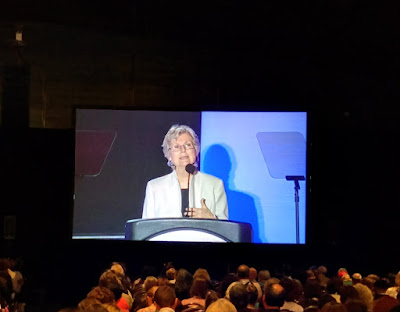
SLA 2015 Closing Keynote Speaker Kim Dority, Dority & Associates

Kim Dority SLA 2015 Keynote Speaker

The closing message or take away from the 2015 SLA Conference

The Take Away Message


Tuesday, June 16, 2015

SLA 2015 INFO-EXPO Snap Shots

I attended the 2015 SLA INFO-EXPO twice. Here are some snap shots of that experience.


Tuesday, September 23, 2014

Chapter 3 & 4 Reflection [Miller, S. J. (2011). Metadata for digital collections. Newyork: Neal-Schuman]


Metadata creation is part art and part science. The art is in how one uses language to create metadata to describe something, and the science is using the rules of a given metadata scheme. Some of the Dublin Core metadata recommendations are quite confusing. I found the coverage, relation, and source terms to be most troubling. I can see it will take practical experience to develop a better understanding of their application.
I could get lost in subject analysis. I enjoy this kind of thinking, and I do like doing the research subject analysis involves. It is troubling that others see this as a time sink. Nevertheless, I do understand one has to place limits on how much time to spend on solving the problem. Pragmatically there is a balance between subject analysis and tagging. Subject analysis will involve a controlled vocabulary but, what about tagging. Some user might be searching for a "red" boat in my collection of boats. I am curious how the content of an object is analyzed into a balanced granular set of terms that aid search and retrieval. I am not a big fan of putting my "red" boat in only the description field and relying on it being picked up in a query.
I envision one need what is akin to a style guide when creating and assigning metadata to something. Hard copy forms, or index cards with templates for a given metadata scheme could be helpful, and these are tools I would develop for my purposes when making a collection. Each item in the collection has a hard copy or digital template that is filled out before the record is built in the database. This allows one to audit the project before building it as well as facilitating the data entry phase when making the digital collection. Lastly, I can see how training and education in metadata is an important part of building digital collections. I would like to see certification programs developed for metadata.

Metadata Matters

I discovered this blog and thought I would repost it here.

http://managemetadata.com/blog/

Sunday, September 21, 2014

My Reflection on the One-to-One Principle and Metadata


Edward Steffen Morrow Jr.
Metadata for Digital Resources
Reading Reflection: Assignment 1
September 14, 2014

Reference to this Article
Miller, S. J., & 10th International Conference on Dublin Core and Metadata Applications, DC-2010. (December 01, 2010). The one-to-one principle: Challenges in current practice. Proceedings of the International Conference on Dublin Core and Metadata Applications, 150-164.
A couple of things come to mind after reading the Miller article. My thoughts (opinions) center on accepted wisdom of standards, competency, and required skills. I like the 1:1 principle. It fits with what I want to see on the Internet. I hold a strong opinion that each resource should be described as a single entity, and every resource should have its own description. Each item should have a separate metadata record. Of the example in the article, I like the options 1 (page 155) and 2 (page 155 – 156). However, these options are not gold standards in my opinion. I think they are appropriate substitutions and fit best with workflows. Despite their drawbacks, I see these options as good teaching example of how-to-create metadata to describe resources.
I see a better solution driven from the examples given in the article as well as from the comments of the author. In my opinion, the major stakeholders need to convene and come to an agreement on what are best practices for resource description. This agreement should take place via open source documentation and group collaboration governed by a working task force. The goal of this task force is to create a set of standards for resource description grounded in the 1:1 principle and submit this documentation to the National Standards Institute and the International Standards Organization. This documentation should include new necessities for OAI harvesting whereby the harvesting protocols flag ambiguous metadata for correction and clarification. The OAI harvesting protocols need fixing, so they do not allow ambiguous metadata into the record. The system should have a set of checks and balances that explicitly state and identify when the 1:1 principle is violated as well as identifying the ambiguous metadata.
I also believe that the time has come to require specific training in the 1:1 principle. This training should be at the bedrock of all metadata creation documentation. The 1:1 principle should be a gold standard that all software has to meet based on NSI and ISO certification requirements. In other words, new digital resource platform software should be rooted in the 1:1 principle. Stakeholders should only use software certified by the NSI or ISO that is 1:1 certified. Old software that does not meet the 1:1 principle needs to be phased out by a selected target date. My idea may seem like a radical approach. In my opinion, the future of the Internet depends on it for reasons of integrity, quality, and efficiency.
I also feel that the individuals charged with describing resources on the Internet should be required to have the appropriate training and or certification in the 1:1 principle. Consequently, resources identified in a fashion that does not follow the 1:1 principle should be explicitly identified as violating the standard so users can make better-informed judgments about the quality of the metadata.
I like how the book clarifies that metadata is a human construct with multiple components. In addition, I understand that metadata is a tool humankind uses to make sense of the information on the Internet. I also appreciate that metadata is a structured use of language and that metadata schemes exist to impart order to the chaos everyday language imparts when used for descriptive purposes. I do like Dublin Core, but it has many limitations when it used to describe resources with multiple manifestations. In this case, more than one manifestation. I like that Dublin Core offers customization options to create new elements. However, I found the creation of new elements made me really question and ponder how an item is described. My thoughts often delved into the metaphysical realm. I found myself drawing diagrams and bubble maps to put boundaries and connections between the words I wanted to use to describe a particular resource. The act of creating a metadata element with paired values is an art as well as a science in my opinion. It is an action where ignorance can produce unintended effects.
I feel metadata creation and its study is a worthwhile topic. It is a core component of digital resources and worth exploring. The Internet needs people who are skilled in the creation of quality metadata. I look forward to learning more about metadata and its application it to digital and analog resources.